

If you are trying to figure out the right care for a parent or loved one with dementia, you have probably come across two terms a lot: dementia care and memory care. Many families use these words as if they mean the same thing. But they are not the same, and picking the wrong type of care can affect your loved one’s safety, comfort, and quality of life. The confusion is completely understandable. Both types of care involve helping people with memory and cognitive problems. But they differ in where care is given, how it is structured, and who it is best suited for.
This guide breaks down exactly what dementia care and memory care mean, how they are different, and how to figure out which one is right for your family. At Home Halo, we provide specialized in-home dementia care so seniors can stay safe and comfortable in the place they know best.
Understanding Dementia Care
What Is Dementia Care?
Dementia care is a broad term. It refers to any kind of support and assistance given to a person who has been diagnosed with dementia. This includes help with daily tasks, managing behaviours, keeping the person safe, and making sure their emotional needs are met. Dementia is not one single disease. It is an umbrella term that covers several conditions, including Alzheimer’s disease, vascular dementia, Lewy body dementia, and frontotemporal dementia. Each type affects the brain differently, but all of them cause a decline in memory, thinking, and the ability to handle daily life.
Dementia care is designed to meet the specific needs that come with these conditions. It can be given in many different settings, and it covers a wide range of support levels depending on how far the disease has progressed.
Where Dementia Care Can Be Provided
One of the biggest things that sets dementia care apart from memory care is that it is not tied to one specific setting. Dementia care can happen:
- In the home, where a trained caregiver comes to help your loved one
- At adult day care programs, which offer daytime supervision and activities
- In assisted living communities that have staff trained in dementia support
- In memory care facilities, which are a specialized type of dementia care setting
- In skilled nursing homes for those who need medical care alongside dementia support
This flexibility is one of the reasons dementia care works well for so many families. It can be adjusted as needs change over time.
What Services Are Included in Dementia Care?
The services offered through dementia care depend on the setting and the level of support needed. In general, dementia care includes:
- Help with bathing, dressing, grooming, and other daily activities
- Medication reminders and basic health monitoring
- Meal preparation and making sure the person gets proper nutrition
- Emotional support and companionship throughout the day
- Communication and behavioural support for things like confusion, anxiety, or mood changes
- Guidance and education for family members who are also caregiving
What Is Memory Care?
Memory Care Definition
Memory care is a specific type of long-term care that takes place in a residential facility designed for people with moderate to advanced dementia or Alzheimer’s disease. These facilities are built around the needs of people who can no longer live safely at home, even with caregiver support.
Memory care communities were developed because regular assisted living or nursing homes were not always equipped to handle the unique challenges that come with dementia. Wandering, aggression, confusion, and the need for constant supervision require a very different environment and trained staff.
In a memory care facility, everything from the layout of the building to the daily schedule is designed to support cognitive decline and reduce the risk of accidents or distress.
Who Typically Needs Memory Care
Memory care facilities are generally the right fit for seniors who are in the moderate to advanced stages of dementia. This includes people who:
- Wander and are at risk of getting lost or hurt
- Become confused, disoriented, or agitated without constant supervision
- Can no longer perform basic daily tasks without hands-on help
- Have behavioural symptoms that require a structured, secure environment
- Are no longer safe living at home, even with a caregiver present
Services Offered in Memory Care Facilities
Memory care facilities provide a high level of around-the-clock support. Common services include:
- 24-hour supervision by trained staff
- Secure environments with locked doors and monitored exits to prevent wandering
- Structured daily routines to reduce confusion and anxiety
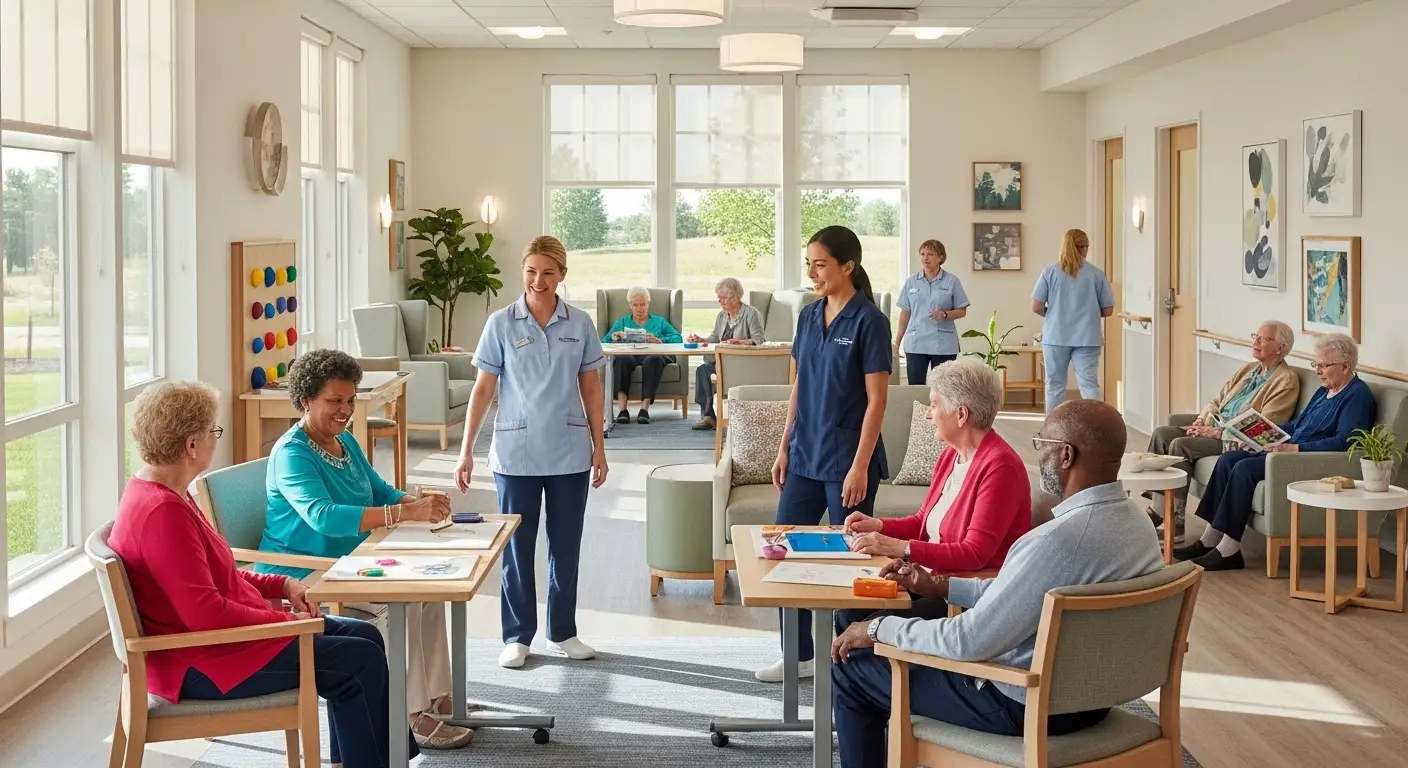
- Cognitive stimulation programs like music therapy, art, and group activities
- Medication management by nursing staff
- Therapeutic activities and social programming designed for people with dementia
Are Dementia Care and Memory Care the Same Thing?
No, they are not the same, but they are closely related. Here is the simplest way to understand it:
Memory care is a type of dementia care. But not all dementia care is memory care. Dementia care is the broader category. It covers any kind of support given to someone with dementia, no matter where it happens or what stage they are in. Memory care is one specific option within that category. It refers to care given inside a residential facility built specifically for people with dementia who need constant supervision and a secure setting. So when families say they are looking into dementia care, they could be talking about in-home care, adult day programs, assisted living, or memory care facilities. When they say memory care, they are talking about one particular type of facility-based care.
Dementia Care vs Memory Care: Key Differences
1. Care Setting
Dementia care can happen at home, in a day program, in assisted living, or in a memory care facility. Memory care always takes place inside a dedicated residential facility. For many families, in-home dementia care is the preferred choice, especially in the earlier or middle stages. Being at home means familiar surroundings, a familiar routine, and less disruption for the person with dementia. Memory care facilities become more relevant when staying at home is no longer safe or manageable.
2. Level of Supervision
In-home dementia care can be scheduled for a few hours a day, several days a week, or even full-time depending on what the family needs. Memory care facilities provide 24-hour supervision every day of the year. If your loved one needs someone nearby at all times, especially at night, a memory care facility offers that level of coverage in a way that in-home care may not always match, depending on the budget.
3. Staff Training and Expertise
Both in-home dementia caregivers and memory care facility staff should be trained in dementia-specific care. This includes understanding how to communicate with someone who has cognitive decline, managing behavioural changes, and responding to crises calmly and safely. The quality of training matters a lot. Families should always ask about what training caregivers or staff have received before choosing any care option.
4. Safety and Security
In-home dementia care usually involves safety modifications to the home. This might include removing hazards, installing door alarms, using medication dispensers, and adding grab bars or non-slip surfaces. A trained caregiver also provides supervision during their hours. Memory care facilities are built with safety in mind from the start. Secure perimeters, monitored exits, and a layout designed to reduce confusion are all standard features. For someone who wanders frequently or is at high risk for falls, this level of security is harder to replicate at home.
5. Activities and Cognitive Engagement
In-home dementia care allows for personalized activities based on what the individual enjoys. A caregiver can take a walk, work on a puzzle, look through old photos, or just sit and talk. This one-on-one attention is something memory care facilities cannot always offer. Memory care facilities typically run structured group programs. These are designed by activity specialists and can include music therapy, art classes, reminiscence groups, and gentle exercise. For social seniors, these programs can be very beneficial.
6. Flexibility of Care
In-home dementia care is highly flexible. You can start with a few hours a week and increase as needed. You can choose morning or evening help based on when your loved one needs the most support. Memory care facilities follow set schedules and routines. While this structure can actually be helpful for someone with dementia, it does mean less customization for individual preferences.
7. Cost Comparison
Memory care facilities usually involve a fixed monthly cost because they provide housing, meals, daily activities, and staff supervision around the clock. The exact price can vary depending on the location, the services offered, and the level of care a resident needs.
In-home dementia care is often more flexible because families can choose how many hours of support they need. Some families start with a few hours of help each day and increase care as their loved one’s needs change. This flexibility can make in-home care a practical option for families who want their loved one to remain in familiar surroundings while still receiving professional support.
Quick Comparison: Dementia Care vs Memory Care
| Factor | In-Home Dementia Care | Memory Care Facility |
| Setting | The person’s own home | Dedicated residential facility |
| Supervision | Flexible, scheduled hours | 24 hours a day, 7 days a week |
| Personalization | High, one-on-one focus | Moderate, group-based routines |
| Staff Expertise | Dementia-trained caregivers | Specialized dementia teams |
| Best For Stage | Early to moderate dementia | Moderate to advanced dementia |
| Familiar Environment | Yes, stays at home | No, new residential setting |
In-Home Dementia Care: Benefits for Seniors and Families
Advantages of Dementia Care at Home
There is a lot of research suggesting that people with dementia do better when they stay in familiar surroundings. Being at home means your loved one sees the same walls, the same furniture, and the same neighbourhood they have known for years. That familiarity can reduce confusion and agitation. In-home dementia care also makes it easier for family members to stay closely involved. You are not driving to a facility to visit. You can be present, check in regularly, and be part of daily decisions about care.
Other advantages include:
- Personalized one-on-one support that is tailored to your loved one’s personality and habits
- More control over daily routines, meals, and activities
- A slower, less disruptive transition as needs change over time
- Greater independence and dignity for the person receiving care
How Home Halo Supports Families
At Home Halo, we build customized care plans based on each person’s specific needs and preferences. Our caregivers are trained in dementia care and understand how to build trust with someone who has cognitive challenges. We offer flexible scheduling, so families can get help for a few hours a week or full-time coverage. Our caregivers assist with daily living tasks, provide companionship, monitor safety at home, and keep family members informed about how things are going.
Our goal is simple: to make it possible for your loved one to stay home longer, safely and comfortably.
When Memory Care May Be the Right Choice
There are situations where a memory care facility becomes the safer and more practical choice. These include:
- Advanced dementia where the person needs constant supervision and hands-on help around the clock
- Frequent wandering that puts the person at serious safety risk at home
- Aggressive or unpredictable behavioural symptoms that are difficult to manage at home
- Family caregivers who are burned out and no longer able to provide safe care
- Medical needs that require nursing oversight beyond what home care can provide
Benefits of Memory Care Communities
Memory care facilities offer a secure, structured environment with staff who are present at all hours. For someone in the advanced stages of dementia, this consistency and security can genuinely improve their day-to-day quality of life. Residents also benefit from regular social interaction with peers, professionally designed activity programs, and access to medical support on-site.
Dementia Care vs Assisted Living
- Assisted living communities provide help with daily activities for seniors who need some support but are still fairly independent. Many assisted living communities accept residents with early-stage dementia.
- However, assisted living is not the same as memory care. Assisted living staff are not always trained in dementia-specific care, and the environment is not always designed with cognitive decline in mind.
- As dementia progresses, many residents in assisted living eventually need to transition to a memory care facility. If your loved one has been diagnosed with dementia, it is worth asking any assisted living community specifically what level of dementia support they are equipped to provide.
Memory Care vs Nursing Homes
- Nursing homes provide a high level of medical care for seniors with serious health conditions. They are staffed by nurses and can manage complex medical needs.
- Memory care facilities focus specifically on cognitive decline and dementia. While some nursing homes have dedicated memory care units, a standalone memory care community is entirely built around dementia care in a way that most nursing homes are not.
- Nursing homes may be the right choice when a person with dementia also has significant physical health needs, such as wound care, IV medications, or rehabilitation after a hospital stay. For someone whose primary need is dementia management without major medical complexity, a memory care facility or in-home care is usually the better fit.
Signs Your Loved One May Need Professional Dementia Care
It can be hard to know when to bring in professional help. Here are some signs that it may be time to look into dementia care options:
- Increasing confusion about time, place, or the identity of familiar people.
- Difficulty managing medications, leading to missed doses or accidental double doses.
- Declining personal hygiene or forgetting to eat regularly.
- Wandering or getting lost in familiar places like the neighbourhood.
- Behavioural changes such as increased anxiety, agitation, or sudden anger.
- Family caregiver stress, exhaustion, or their own health beginning to suffer.
These signs do not mean you have failed. They mean your loved one’s needs have grown to the point where additional professional support will help everyone, including you.
How to Choose the Right Care Option
Evaluate the Stage of Dementia
Early-stage dementia often means the person can still do quite a bit independently. A few hours of in-home support per week may be all that is needed. As the disease moves into moderate and advanced stages, the need for more intensive supervision and hands-on help increases. This is when memory care facilities often become part of the conversation.
Assess Safety at Home
Walk through the home with an honest eye. Are there fall hazards? Is your loved one taking medications correctly? Are they wandering outside at night? These safety factors play a big role in whether in-home care with modifications is feasible or whether a more secure environment is needed.
Consider Family Caregiver Capacity
Family members often take on a huge amount of the care burden. That is admirable, but it is also exhausting. If family caregivers are burning out, that affects the quality of care the person with dementia receives. Bringing in professional in-home help can relieve that pressure without requiring a move to a facility.
Compare Costs and Long-Term Care Planning
Think about your budget realistically. In-home care for a few hours a day is far less expensive than full-time memory care. Some families use a combination of family caregiving, in-home professional care, and eventually facility care as needs evolve. Check whether long-term care insurance, Medicaid, or Veterans benefits may help cover some of the costs. A senior care advisor or social worker can help you navigate those options.
Respite Care for Dementia Families
What Is Respite Care?
Respite care is short-term relief for family caregivers. It means bringing in a trained caregiver for a few hours, a day, or even a weekend so the family caregiver can rest, run errands, attend appointments, or simply recharge.
Why Respite Care Is Important
Caregiver burnout is real. Studies consistently show that family caregivers of people with dementia are at high risk for depression, anxiety, and physical health problems. Taking breaks is not a luxury. It is a necessity for sustainable caregiving. When family caregivers are rested and supported, the person with dementia benefits too. The care they receive is more patient, more present, and more effective.
How Home Halo Provides Respite Support
Home Halo offers flexible respite care options for families. Whether you need a few hours each week or coverage for a longer stretch, we can step in so you can step away without worry. Our caregivers are trained and familiar with dementia care, so there is no disruption to your loved one’s routine.
Talk to Home Halo Today
If you are not sure where to start, that is okay. Most families feel the same way when they first begin looking into dementia care. The important thing is that you do not have to figure it all out alone.
At Home Halo, we work with families every day who are in exactly your situation. We listen, we ask the right questions, and we help you build a care plan that fits your loved one’s needs and your family’s life. Whether you need a few hours of help each week or something more involved, we are here to make it easier.
Reach out to us today for a free consultation. We will walk you through your options, answer your questions, and help you take the next step with confidence.
Conclusion
Dementia care and memory care are related, but they are not the same. Dementia care is the broader category that includes in-home care, adult day programs, assisted living support, and memory care facilities. Memory care is one specific option within that category, built for people who need a secure, supervised residential setting. The right choice depends on where your loved one is in their dementia journey, what kind of support is available at home, and what level of safety and supervision they need. There is no one-size-fits-all answer, and most families find that their needs evolve over time. What matters most is that your loved one feels safe, cared for, and as comfortable as possible. You do not have to figure this out alone. Home Halo is here to help families navigate dementia care at home. Whether you need a few hours of support each week or a more comprehensive plan, we can work with you to build something that fits your family’s needs. Reach out today to learn more about how we can help.
Frequently Asked Questions
What is the main difference between dementia care and memory care?
Dementia care is a broad term for any support given to someone with dementia, wherever it happens. Memory care refers specifically to care provided in a residential facility designed for people with moderate to advanced dementia who need constant supervision and a secure environment.
Do dementia patients do better at home or in memory care?
Research generally shows that people with dementia do well in familiar environments, which supports in-home care in the earlier and middle stages. However, as dementia advances and safety risks increase, a memory care facility may offer better protection and consistency. The right answer depends on the individual’s needs and how much support the family can provide.
When should someone move to memory care?
A move to memory care is worth considering when the person with dementia is no longer safe at home, is wandering or at high fall risk, has behavioural symptoms that are difficult to manage, or when family caregivers are no longer able to provide safe care on their own.
How long can someone with dementia stay at home?
There is no set timeline. Many people with dementia live at home for years with the right support in place. The key factors are the stage of the disease, the safety of the home environment, and how much help is available from family and professional caregivers.
What should families look for in a memory care facility?
Look for staff who are specifically trained in dementia care, a secure and well-designed environment, structured daily routines, a reasonable staff-to-resident ratio, a program of meaningful activities, and a warm and respectful approach to residents. Visiting in person and talking to current families is one of the best ways to evaluate a facility.