


Caring for a loved one with dementia can change gradually. At first, a family may notice forgotten appointments or repeated questions. Later, preparing meals, getting dressed, managing medications, staying safe at home, or following a familiar routine may become more difficult. For families exploring dementia care at home in Massachusetts, the goal is often not simply to find someone who can complete a list of tasks. It is to build the right support around a person so they can remain in a familiar environment while receiving help that respects their preferences, routines, and changing abilities.
Dementia is a general term for changes in memory, thinking, language, problem-solving, and other abilities that become significant enough to interfere with daily life. Alzheimer’s disease is the most common cause of dementia, but there are several forms and causes. Families who want a broader overview can review the Alzheimer’s Association explanation of dementia.
Home care cannot treat or diagnose dementia. What it can do is provide consistent, non-medical support with the everyday parts of life that often become more challenging as dementia progresses. Families looking for step-by-step caregiving strategies can also read Home Halo’s guide on how to care for someone with dementia at home. This Massachusetts guide focuses more specifically on local care options, resources, and decisions.
What Is Dementia Care at Home?
Dementia care at home is personalized support provided where the person already lives. Rather than moving into a residential memory care community, a person may receive assistance from professional caregivers while continuing to live in their own house, apartment, condo, or family member’s home.
The amount of care can vary considerably. Someone in an earlier stage of dementia may need companionship, meal preparation, and reminders for a few hours at a time. Another person may require frequent assistance with personal care, mobility, routines, and safety throughout the day.
-
- Personal care such as bathing, dressing, grooming, and toileting
- Meal preparation and support with regular mealtimes
- Medication reminders
- Companionship and conversation
- Help maintaining familiar daily routines
- Light housekeeping and laundry
- Mobility assistance
- Transportation and errands when appropriate
- Meaningful activities based on the person’s interests
- Safety awareness and supervision
- Respite for family caregivers
Home Halo provides person-centered in-home dementia care designed around each individual’s history, interests, routines, and current needs. Care plans can also change as a person’s needs evolve.
In-Home Care for Seniors & Veterans
Compassionate, personalized in home care designed to help seniors live safely and independently in the comfort of home. Our trusted home care services provide daily support, companionship, and specialized senior home care giving families peace of mind every step of the way.
Why Families May Consider Dementia Care at Home
There is no single point when every person with dementia suddenly needs professional care. More often, families begin noticing small changes that become harder to manage without additional support.
A parent who once prepared dinner every evening may stop cooking because following multiple steps has become confusing. Someone who has always managed their own household may begin wearing the same clothes repeatedly or forgetting to complete basic routines. A spouse providing care may gradually take on more responsibility until there is little time left to rest, work, or manage their own health.
The question is not always, “Can my loved one still live at home?” A more useful question may be, “What support would help my loved one continue living at home as safely and comfortably as possible?” Home care can become one part of that support system.
Signs a Loved One With Dementia May Need More Help at Home
Families often notice changes before the person living with dementia recognizes that additional help would be useful. One missed meal or forgotten appointment does not necessarily mean someone needs professional care. Patterns, however, deserve attention.
-
- Meals are frequently skipped, forgotten, or difficult to prepare safely.
- Bathing, dressing, grooming, or toileting is becoming harder to complete consistently.
- Medication routines are confusing or doses are repeatedly missed.
- The person is withdrawing from familiar activities or social interaction.
- Household tasks, laundry, dishes, mail, or basic upkeep are becoming difficult to manage.
- The person becomes disoriented in familiar places or needs increasing supervision.
- Walking has become less steady, or there have been falls or near falls.
- A spouse, adult child, or other caregiver is exhausted or can no longer provide all needed support.
Sudden or significant changes in memory, behavior, alertness, mobility, or functioning should be discussed with a healthcare professional rather than automatically attributed to dementia. Medical problems, infections, medication effects, dehydration, pain, and other conditions can sometimes contribute to new confusion or behavior changes.
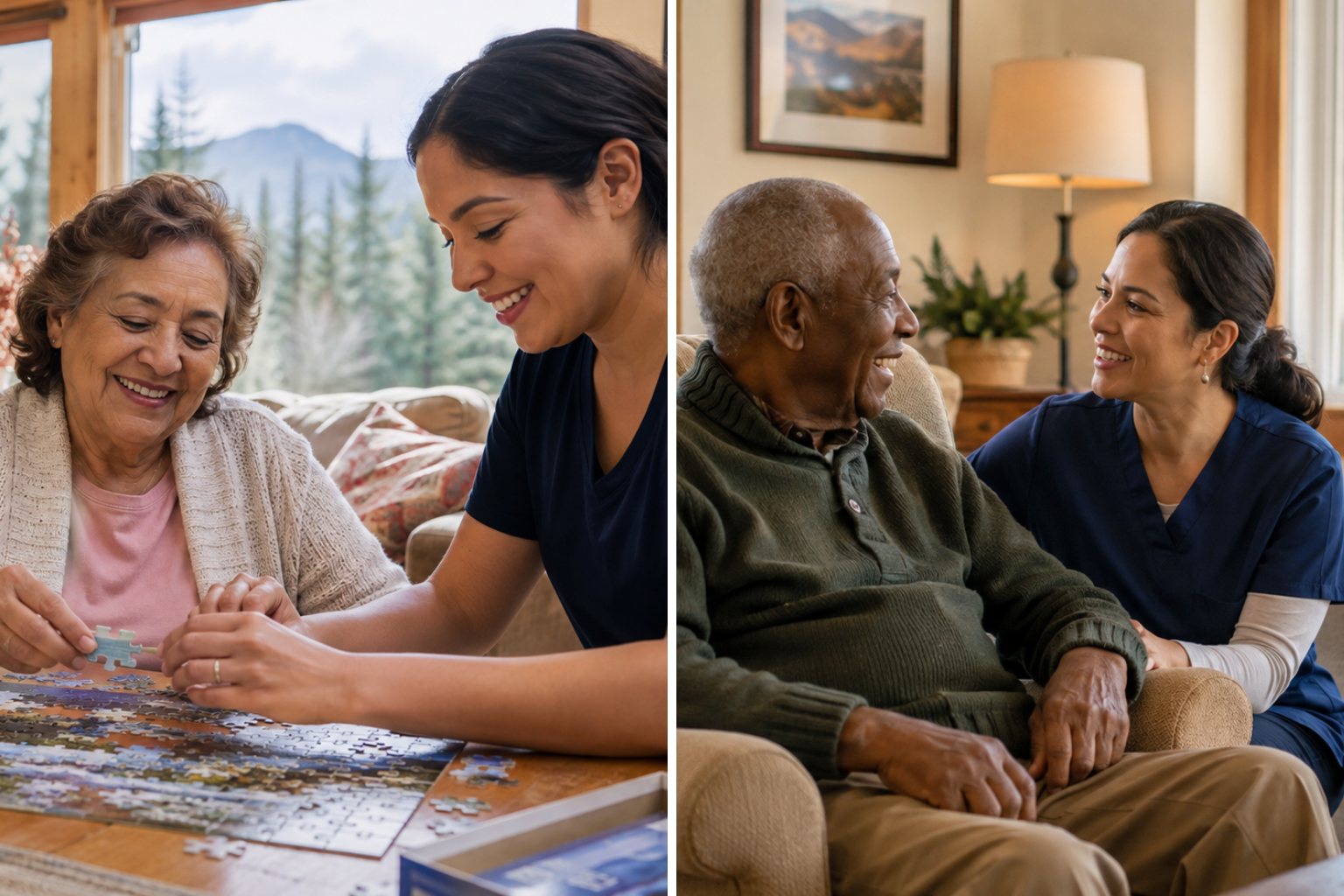
How In-Home Dementia Care Can Support Daily Routines
For someone living with dementia, ordinary routines can become increasingly complicated. Getting out of bed, choosing clothing, preparing breakfast, and starting the day may involve dozens of small decisions. A caregiver can help simplify those routines without unnecessarily taking control away from the person.
Personal Care
Bathing, grooming, dressing, and toileting may become more difficult because a person forgets the steps involved, becomes uncomfortable with assistance, or has physical limitations in addition to dementia. Respectful personal care assistance can provide the amount of help the person needs while protecting privacy, dignity, and personal preferences.
Instead of rushing through a routine, a caregiver can offer simple choices, allow additional time, explain each step, and provide assistance according to the person’s current abilities.
Meals and Hydration
Dementia can affect a person’s ability to plan meals, shop for food, remember whether they have eaten, or safely use kitchen appliances. Caregivers can prepare meals, provide reminders, keep mealtimes consistent, and offer companionship while the person eats.
Any medical concerns involving swallowing, nutrition, dehydration, or significant weight changes should be discussed with the appropriate healthcare professional.
Medication Reminders
Managing several medications can become difficult when memory changes progress. Non-medical caregivers may provide medication reminders according to the individual’s care plan, while medication management decisions remain with the client, family, pharmacist, and appropriate healthcare providers.
Families should discuss missed doses, medication errors, new side effects, or significant changes in functioning with the prescribing provider or pharmacist.
Companionship and Meaningful Activities
Dementia care should involve more than completing physical tasks. A person may still enjoy music, gardening, folding towels, baking with assistance, going for a walk, looking through photographs, watching a favorite team, visiting a familiar park, or simply sitting outside.
The activity does not need to test the person’s memory or prove what they can still do. The goal is connection. Activities can be adapted as abilities change so that the person can continue participating rather than always having things done for them.
Why Familiarity and Consistency Matter
Dementia can make unfamiliar environments, people, and routines more difficult to navigate. At home, a person may still recognize their favorite chair, photographs, kitchen, neighborhood, or morning routine even when other parts of the day become confusing.
That does not mean the home automatically remains safe at every stage of dementia. It means families can evaluate whether the home can be adapted and whether additional support can address growing needs.
Consistency can also apply to the people providing care. Learning someone’s preferences takes time. One person may prefer breakfast before getting dressed. Another may become anxious if they feel rushed. Someone may respond well to music but dislike having the television on in the background. Knowing those details helps care feel more personal and familiar.
Creating a Safer Home for Someone With Dementia in Massachusetts
A home that worked well for someone several years ago may need to change as memory, judgment, vision, or mobility changes. Families can begin by looking at the environment from the person’s current perspective.
-
- Keep walkways clear and reduce clutter that may create trip hazards.
- Improve lighting in hallways, bathrooms, stairways, and entrances.
- Keep frequently used items easy to find and place potentially dangerous items securely.
- Review bathroom safety, kitchen appliances, medication storage, and exterior doors.
- Use simple labels or visual cues when they are helpful rather than confusing.
- Review smoke alarms, carbon monoxide alarms, water temperature, and emergency plans.
Massachusetts weather adds another consideration. Snow, ice, wet entryways, freezing temperatures, and early winter sunsets can create additional fall and navigation concerns for older adults. Families may need seasonal plans for snow removal, safe transportation, outdoor walking, grocery shopping, and appointments.
The right modifications depend on the individual. Families can also ask physicians, occupational therapists, and other appropriate professionals for guidance when safety concerns become more complex.
Trusted Home Care Services
At The Home Halo®, we are a trusted home care agency dedicated to providing non medical home care, companion care, and caregiver services that support independence, dignity, and comfort at home.
Supporting Communication With Someone Living With Dementia
Communication can become frustrating when a family member repeats questions, forgets a recent conversation, or understands information differently than they once did. Correcting every mistake is rarely the most important goal.
Instead, focus on what the person may be trying to communicate. A repeated question may reflect uncertainty. Refusing to get dressed may indicate discomfort. Wanting to “go home” while already at home may express a desire for familiarity or reassurance rather than a literal request for another address.
Short sentences, simple choices, a calm tone, and additional processing time may make conversations easier. Whenever possible, speak directly to the person rather than talking about them as though they are not present. Dementia may change communication, but the person still deserves dignity, respect, and involvement in decisions.
Dementia Care Is Also About Supporting the Family Caregiver
Family caregivers often become the invisible part of a dementia care plan. A spouse may provide supervision day and night. An adult daughter or son may coordinate appointments while raising children and working full time. Siblings may divide responsibilities across different cities or states.
Over time, caregiving can become difficult to sustain without help. In-home respite care can provide temporary relief while a person living with dementia continues receiving support with routines, companionship, personal care, meals, and safety at home.
Professional home care does not have to replace family involvement. It can fill the gaps. A caregiver might visit while a spouse attends their own medical appointment, allow an adult child to return to work without worrying about lunchtime routines, or provide evening support several days each week.
Adding help earlier can also give families time to build relationships and establish routines before needs become more intensive.
Massachusetts Resources for Families Caring for Someone With Dementia
Private home care can be one part of a broader support system. Massachusetts families can also use state and community resources to learn about eligibility, caregiver support, care planning, and local programs.
Massachusetts Executive Office of Aging & Independence
The Massachusetts Executive Office of Aging & Independence provides information and resources for older adults, people living with dementia, and family caregivers. Its aging services network connects residents with regional organizations and community programs.
Massachusetts Home Care Program
The state’s Home Care Program provides care management, care coordination, education, and certain in-home or community support services for eligible residents, including adults living with Alzheimer’s disease or related dementia. Eligibility, available services, and cost-sharing can vary.
Aging Services Access Points
Massachusetts Aging Services Access Points, commonly called ASAPs, coordinate local services such as assessments, care planning, home care programs, and caregiver support. Families can use the state’s ASAP locator to identify the organization serving their city or town.
Family Caregiver Support Program
Massachusetts also offers a Family Caregiver Support Program for eligible unpaid caregivers, including people caring for someone living with Alzheimer’s disease or a related dementia. Caregiver specialists can help families identify needs and connect with information, education, and support.
Alzheimer’s Association Massachusetts/New Hampshire Chapter
The Alzheimer’s Association Massachusetts/New Hampshire Chapter offers education, support groups, community programs, and dementia resources for people living with dementia and their families.
Paying for Dementia Care at Home in Massachusetts
Families frequently want to know whether insurance or government programs will pay for in-home dementia care. The answer depends on the person’s coverage, finances, functional needs, military service, and the type of care required.
Many families pay for non-medical home care privately. Long-term care insurance may also cover qualifying services depending on the policy. Veterans and surviving spouses may qualify for certain VA benefits depending on eligibility and the applicable program. Massachusetts residents may also qualify for state-supported home and community programs.
Does Medicare Pay for Dementia Home Care?
Medicare may cover certain qualifying skilled home health services, but it generally does not pay for long-term non-medical custodial care when assistance with activities such as bathing, dressing, housekeeping, or supervision is the only care required. Families should review Medicare’s official home health coverage information and verify benefits based on the individual’s coverage before making financial decisions.
Families exploring state or insurance-supported services should confirm current eligibility directly with the program and ask the home care provider which payment sources it accepts.

How to Choose a Dementia Home Care Provider in Massachusetts
Finding a provider is about more than asking whether the agency offers “dementia care.” Ask how care is actually delivered and how the provider prepares for changing needs.
-
- How are caregivers screened, trained, and matched with clients?
- How does the agency prepare caregivers to support people living with dementia?
- How does the agency learn the person’s routines, interests, history, and communication preferences?
- Who should the family contact when there is a change in behavior, routine, or schedule?
- What happens if the regular caregiver is unavailable?
- Can care hours increase as needs change?
- How are care plans reviewed and updated?
- What services are outside the caregiver’s role?
- Does the agency serve the person’s specific Massachusetts city, town, or county?
Dementia is progressive, so a schedule that works today may not be enough six months or a year from now. Families should understand how the provider adjusts care and how it communicates when a person may need additional medical, clinical, or residential support.
Families comparing home-based support with a residential setting can also review Home Halo’s guide to dementia care vs. memory care.
Dementia Care at Home in Eastern Massachusetts
Home Halo of Eastern Massachusetts provides compassionate, relationship-driven, non-medical home care for seniors and families throughout Essex, Middlesex, Suffolk, Norfolk, Plymouth, Bristol, Barnstable, Dukes, and Nantucket counties.
The service area includes families in and around Boston, Cambridge, Somerville, Quincy, Lynn, Newton, Brookline, Waltham, Malden, Lowell, and many surrounding Eastern Massachusetts communities.
Home Halo’s approach begins with the person rather than the diagnosis. Caregivers take time to learn routines, preferences, interests, and family dynamics so support can feel familiar and respectful. Families who are exploring broader senior support can also review home care for seniors in Massachusetts for an overview of statewide care considerations.
For some families, dementia care may begin with a few focused visits each week. For others, needs have progressed to the point where more consistent support is required throughout the day. The goal is to create a plan based on the person’s current needs while remaining prepared to adjust that plan as circumstances change.
When Is It Time to Reevaluate the Care Plan?
Dementia care should never be treated as a one-time decision. Needs change. A person who once needed companionship twice each week may later need help getting dressed every morning. Someone who was safe alone between caregiver visits may begin wandering, falling, or becoming confused at night.
Families should regularly reconsider whether the current care plan still addresses personal care, nutrition, mobility, medication routines, household safety, social connection, and caregiver stress. Major changes in behavior, mobility, sleep, eating, health, or functioning should also be communicated to the appropriate healthcare professionals.
Sometimes the answer is simply to increase home care hours. At other times, the family may need to add skilled medical services, occupational or physical therapy, adult day programs, additional safety measures, hospice when appropriate, or another level of care. The goal is not to force one arrangement to work forever. It is to continue asking what the person needs now.
Trusted Home Care Services for Seniors & Families
Finding the right home care services for seniors and elderly loved ones can be overwhelming. We make it simple by connecting families with compassionate and reliable in-home care solutions tailored to individual needs.
Frequently Asked Questions About Dementia Care at Home in Massachusetts
Can someone with dementia continue living at home?
Many people with dementia continue living at home when the environment, supervision, medical care, and daily support match their needs. Whether home remains the right setting depends on health, mobility, behaviors, safety needs, available family support, and how dementia progresses.
What does a dementia caregiver do?
A non-medical dementia caregiver may help with personal care, meals, companionship, daily routines, medication reminders, light housekeeping, mobility, transportation, safety awareness, and meaningful activities. Care should be personalized to the individual’s needs and abilities.
Is dementia care at home the same as home health care?
No. Dementia home care generally refers to non-medical assistance with everyday routines, personal care, companionship, and household needs. Home health care involves skilled clinical services provided by licensed healthcare professionals. Some individuals receive both.
What is the difference between in-home dementia care and memory care?
In-home dementia care allows the person to receive support in their current residence. Memory care typically refers to a residential community designed for people with memory-related conditions. The better option depends on the individual’s needs, safety, preferences, available support, and finances.
Can home care provide respite for a spouse caring for someone with dementia?
Yes. Respite care can provide temporary support while a spouse or other family caregiver works, rests, attends appointments, runs errands, or manages other responsibilities.
Are there Massachusetts programs that help family dementia caregivers?
Yes. Massachusetts offers caregiver support through the Executive Office of Aging & Independence, regional Aging Services Access Points, the Home Care Program, and the Family Caregiver Support Program. Eligibility and available services vary by program and location.
Does Medicare cover in-home dementia care?
Medicare may cover qualifying skilled home health services, but it generally does not cover ongoing non-medical custodial care when that is the only care needed. Families should verify their specific coverage directly with Medicare or their insurance plan.
How do I know when my parent needs dementia care?
Consider whether memory or thinking changes are interfering with meals, personal hygiene, medication routines, household safety, mobility, transportation, or the ability to safely spend time alone. Family caregiver stress is also important. You do not have to wait for a crisis before exploring additional support.
Compassionate Dementia Care at Home in Massachusetts
Dementia may change how a person moves through the day, communicates, and completes familiar routines. It does not erase their history, preferences, or need for meaningful connection. The strongest dementia care recognizes both.
For many Massachusetts families, home care can provide an additional layer of support that helps a loved one continue living in familiar surroundings while giving family caregivers more help managing the realities of everyday care.
Home Halo provides personalized dementia care at home in Massachusetts through our Eastern Massachusetts team. Whether your family is beginning to notice changes or already providing significant daily support, we can help you explore a care plan based on your loved one’s routines, needs, and goals.
Ready to Explore Dementia Care at Home?
Connect with Home Halo of Eastern Massachusetts to talk through your family’s current needs and learn how personalized in-home dementia support could fit into your care plan.